Focusing on What Matters: Mastery and Connection

Your life as an artist is significantly complex. Your expectations are often wildly misaligned and the number of roles you must fill are comical. The pressures are the volcanic kind. The self-doubt and imposter syndrome are obnoxiously loud and carry the persistence of a toddler’s tantrum.
At a time when the music industry is in a controlled burn / reboot, I’ve been dwelling lately on meta principles that an artist like you can, and should, anchor to while the dust settles. I am quite loathe to give generic artist advice as it can dismissively brush aside the undeniable significance of each artist’s unique circumstances and variables, which are critical pieces of information. In my practice, I almost never give the same counsel to multiple artists with the same flavor and nuance. Despite the need for bespoke direction, I believe, after much thinking, I have landed on something broadly useful and accurate.
Here goes…
There are two areas of critical and foundational focus that I believe you should properly fix your sights on.
1. Mastery Of Your Craft
Fairly obvious, is it not? If you haven’t noticed, there is not much attention paid to B or C level music in the listening ecosystem. While releasing steady “content” is arguably the right move for algorithmic goals and audience building, music (the art, remember?) needs to live on a different plane and timeline.
There is absolutely NO substitute for time on task, writing and creating absolutely unlistenable mediocrity in order to find your best material. Your A+ songs are undeniable, you feel it, and others can acknowledge it whether they “like it” or not. And you know you are tricking yourself when you anoint a song an A+ simply because of recency bias.
Aim higher, with a stricter standard for yourself. Your goal should be nothing less than creating music that leaves an indelible mark. Mastery means dedicating yourself to the arduous and often frustrating process of refining your craft until it reaches that unmistakable level of excellence. Are you going to mostly fall short on this? Yes.
Consider this: an entire career can be built on the back of ONE A+ song. Just one. What does it take to create it? Nothing short of everything. It requires relentless dedication, countless hours of practice, and the willingness to push through creative blocks. It demands that you continually challenge yourself, embrace feedback, and never settle for mediocrity.
To achieve mastery, immerse yourself in the process. Analyze the work of artists you admire, deconstruct their techniques, and apply those lessons to your own creations. Write, record, and perform tirelessly, always striving to improve. Accept that failure and frustration are part of the journey, and use them as fuel to propel yourself forward. All this effort doesn’t mean these creations need to see the light of day either. (I have 75 blog posts I have not released because, well, they objectively suck. Consider yourself lucky not to have wasted your time reading them.)
Ultimately, mastering your craft is about more than just technical skill. It’s about developing a unique voice and vision, and conveying that through your music. It’s about creating something that resonates deeply with listeners, something that stands the test of time. And it all starts with an unwavering commitment to excellence.
If you are struggling with prioritizing your craft lately, let’s apply a practical Eliminate-reduce-raise-create grid to get you headed in the right direction.
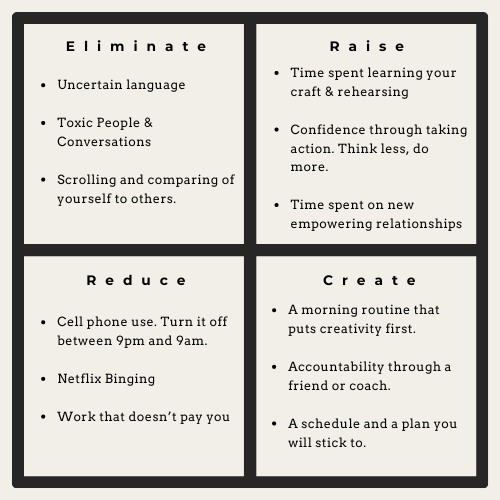
If mastery becomes a foundational, day-to-day focus, your musical life will experience incremental progress and improvement (what happiness feels like), or with a little luck, non-linear growth.
You know what else happens when you make this an intentional focus?
You will gain respect and credibility and more people will want to help you, which takes us to number 2.
2. Width & Depth of Your Community
Gathering a group of good humans who are genuinely supportive of who you are and what you are building has sweeping ramifications.
In life you only need a few people who you can unequivocally count on in the most difficult of moments. In your music career, you need an army to move mountains, open doors, or pull levers with or without your request to do so.
It is not feasible to undertake this alone, as there is an excessive amount of friction and subtlety to navigate. Your voyage benefits and accelerates from a stiff gale of good will and support.
Width — The type of people in your community should include those from many specialties and walks of life. Managers, A&R, publishers, distributors, lawyers, journalists, producers & engineers, photographers, stylists, video directors, consultants, mentors, publicists, digital marketers, music supervisors & sync agents, graphic artists, studio owners, venue owners & bookers, and educators. And thats just music-related, you should diversify with the music-adjacent, like film makers, ad agency creative directors, financial advisors, entrepreneurs, designers, and investors. This allows for cross pollination and connection points you could never imagine and can only see in hindsight.
Depth — Depth of your community requires a genuine interest in others and the understanding that a significant portion of your community will not generate value outside of camaraderie and cheerleading in the short term. That’s not nothing. You don’t build depth by expecting a result or angling for one. If you are inauthentic in community building, it’s both obvious and a waste of everyone’s time. Depth is initially built on giving rather than receiving. Doing things for others creates value and trust.
The conversations you have along the way will enrich your life and widen your aperture, spawning new ideas and making it strikingly evident that you have been playing too small. Trust me. I just returned from a trip to Los Angeles and had my eyes opened to all the things and people I didn’t know. It was humbling, exciting, and motivating.
The people in it should consist of quality human beings with a reputation for kindness, integrity, and professionalism. Don’t settle and never work with assholes, especially those who dangle “opportunities” that tickle your spidey senses.
The way you know that someone belongs in your network and has the right intentions and spirit is when doors are opened and gestures extended with no expected reciprocation. Let that be a crystal clear marker of authentic support. To borrow a line from Robert DeNiro “When there is any doubt, there is no doubt.”
“But Patrick, I’m an introvert and dread networking!”
I called it a community and not a network for that reason. For some of you, the word ‘networking’ can produce a gag-like reflex, similar to when someone says ‘moist’ or ‘cottage cheese.’ I get it; I still have a shy 12-year-old living rent-free in my mind, too. The dread you feel when you think of networking is a remnant of past pain and is largely habitual. It has nothing to do with who you are and certainly not who you are becoming.
The remedy? As the saying goes, the way to appear interesting is to be interested. If you can build the habit of being genuinely interested and curious about others, you will not only come off as interesting and someone others want to be around, you will also gain confidence and you might just learn something! Assume people know something valuable that you don’t.
Networking isn’t about talking to others as much as it is about listening, and listening is far less scary an endeavor than talking, is it not? Play the long game, because it is one. Be patient, thoughtful, genuine, and honest. Much like mastering your craft, this requires time on task.
Practical Challenge: Feeling stuck in a bubble?Start conversations with 3 new connections each week for a month. Watch what happens.
I understand that searching for a hack, shortcut, or seemingly magical strategy for rapid progress can be incredibly enticing, but do not succumb to this illusion. It often leads to getting burned or burning out.
The mastering of your craft and building of your community are the result offocus and consistenteffort, both of which are under your direct control. I understand that it’s harder this way, but its where the payoff lives.
I know you have been at this for a while, or perhaps even a long, long time.
It ain’t over. Keep building.
Soundtrack courtesy of “It Aint Over” by Foy Vance.

This is an impeccable piece of songwriting that nods to Jean Paul Sartre’s character Mathieu Delarue from his series of novels entitled ‘The Roads to Freedom,’ deeply rooted in themes of individual freedom and the responsibility of determining one’s development through acts of will.
